7.8.09

On (Design) Bullshit


Excellent article by Michael Bierut at Design Observer (need to add this to the links on blog)

Read article here

"So into this vacuum rushes the bullshit: theories about the symbolic qualities of colors or typefaces; unprovable claims about the historical inevitability of certain shapes, fanciful forced marriages of arbitrary design elements to hard-headed business goals."

Please also read the discussion below the article between Bierut and fellow writer Rick Poynor because this is a refutation and further explanation.

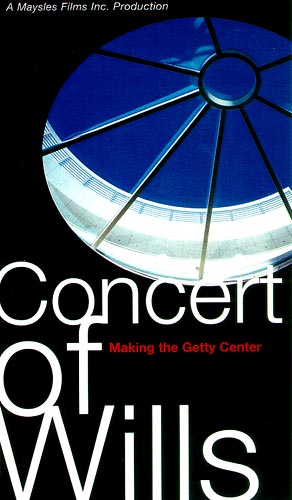
As referenced in article : DVD here

4.8.09

Do not fuck with graphic designers

Do not fuck with graphic designers

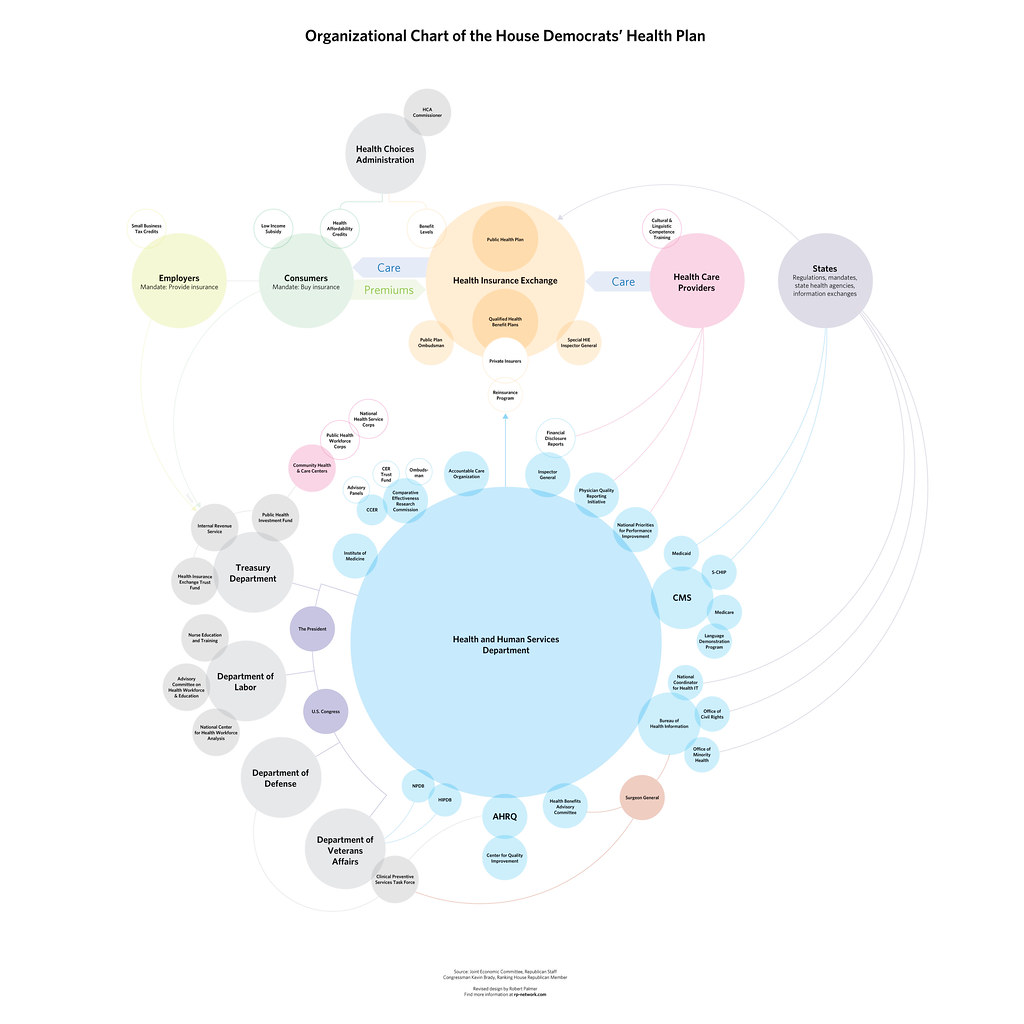
Check out this wonderful post over at Boing Boing. I am not one to jump on the opposition bandwagon, but maybe this somehow accurately defines the separation between a liberal mind and a conservative mind, or more accurately, a designer mind and a builder mind. This is not to say that there exists shades of gray between engineers and architects, but I have to admit my frustration with engineers that "working" graphics like those provided by republicans to illustrate the current health plan.

27.7.09

posted sketch


just keeping the sketches going on office plots that would otherwise be headed to the recycle center. this one was on a 24x36 sheet and is centered and about 14x9 or something close. changing scales increases the ability to shift mediums and play with the palette.

kyle would you be up for a trace of this one? the others looked sweet. i wonder if we could blow those up really big if they would look good still?

18.7.09

beach b0dies


Here are some sketches that I did last Fall while visiting Los Angeles. A friend and I went to Venice Beach and just went out, sat down and enjoyed the surf and sand. As I was sitting there I realized that most of the people started to look a lot like they were part of the horizon. In fact, there seemed to be very little difference between legs, faces and sand. In deed, these people were part of the setting, they were the context.

Thinking back these are indelibly connected to the ideas behind the face sketches I did on the train. Those faces are not just random people sitting on the train, but rater the life-blood of the city. They too, are the context to which I feel architecture must most readily respond to. Both of these sets are also linked very intriguingly to a project Jeff Nesbit and I did just before we left Lubbock. I think you al have seen those profiles, but I can post them here, too if you'd like. Later, I will tell you more about the faces on the trains. For now, here are the beach profiles I did quickly.

Scan-Hands

Okay, here's a brief digression from the wonderful sketch theme we have going on (which I will add to in just a moment). As I was scanning a few sketches to add to the blog and listening to some amazing tunes I was struck with an idea. So here's the idea...

As I was manning the scanner and listening to Animal Collective's album Merriweather Post Pavilion (no blogging-pun intended) I was tapping my hand and loving the moment. Then I began to think of this tapping in terms of my body acting as an extension of and marker for the actual music. In a way, a physical manifestation of an audible creation. For the record, I have been think of the human body in relation to architecture, site, creative processes, forms of measurement and many other contexts quite a bit lately. Meanwhile, back at the ranch: I started to wonder how this movement/extension/marking could be used to possibly make a visual manifestation of the sound as well as a physical one. If I could some how map the movement caused by the music, would I then actually be mapping the music...or at least an interpretation or derivative of that music? I think so, but I just had to try and see what could come of it.

So I realized, as I sat next to the scanner that I should put my hand in the scanner and tap, wiggle, shake, etc...(or hand-dance) to the music as I scanned images of the movement that was then generated. The scanner is key here, because I photograph would copy all of the movement, but in a blurred fashion. This would also map the music, but in a more over-all manner rather than as a collection of brief instances. A photo (with a left open aperture) would capture the space of movement, not the rhythm of it. On the other-hand, the scanner, with its limited recording depth would only capture the moments when the hand was close enough to the bed to actually register the placement. This shows instance more than movement (I think).

So then I did it. I listened to two songs from the album. First, track #2, "My Girls" (because this is the song that started the tapping in the first place) and #5 "Daily Routine" because it is what was playing after I got the first set of images organized and named. Needless to say, it was done quickly. then I just started to play with it to see what would happen. I took five of the scans from each song (as in five fingers) and layered and grouped them as I saw fit. Then In Photoshop I deleted the background of each image and then just played with a tool that I do not use very often (the hue, saturation and lightness command). I would pair a hand scan from each set do a similar edit to each and then re-pair each with a new scan from the other set and edit each pair similarly. I did three quick iterations. One for each component of the command explored. Yes, there is some arbitrariness to this process. Remember, I was just taking a break from my other work and playing.

Anyway, the set below are the results. the first column holds the scans from "My Girls". The last column are those from "Daily Routine". The middle column are the combinations of the other two corresponding columns. The first iteration is at the top, and they are organized sequentially from there. It's not much, but it was fun and I got some practice on both a creative and technical level. What do you brethren think?

15.7.09

charrette sketch project : jdubz01

sorry long time coming - here are two sketches i did of some people at the bar last week. it was a mixer happy hour and this was way before the happy started.


12.7.09

Michael Arthur


As a continuation of the recent topic of real-time drawing, I came across an artist that constantly does just that. Though for Michael Arthur, his moments come from various environments, such as ballet, theatres, music, and everyday experiences like subway rides. His work seems to be percise but through the use of sketch methods.
Find his website here Michael Arthur

7.7.09

Charette: Sketch project

J+Bs was the prime location for this

Inspired by Nason's recent post, and Woods' assignment, I think we should employ a small charette within The Big. Each of us have a week to sketch the idea of a space. Like many studio assignments, this one is completely open to interpretation. I would like to see each of us encourage our sketching skills. So take the sketchbook to the coffee shop, the laundromat, the bar, the bordello, wherever.
The city is often thought of as an ensemble of buildings and the people who inhabit them, establishing a particular way of living that combines the private and the communal. It is useful to remember that a city is also an ensemble of open spaces that are largely public, where private and communal life are openly shared. ~Lebbeus Woods

6.7.09

faces on the train, part 0ne

During my summer studies with Cornell University, I have recently had the extreme pleasure to be involved with a short, yet intensive seminar taught by Professors Lebbeus Woods and Christoph a. Kumpusch. In a rather inadequate nutshell: during the course of the two weeks we worked together we investigated the ground plane of New York City in order to deepen our collective understanding of people and their interactions with and uses of their urban environments. Here, we approached the ground plane as a palimpsest of what has gone before, as a record of how a city is truly used and understood. If we could uncover something from this examination, we could then expand upon our understanding of our city. From this understanding a new city could be revealed. A deeper and more eloquent explanation of the seminar can be had by Professor Woods, himself on his blog at:

Lebbeus Woods Blog

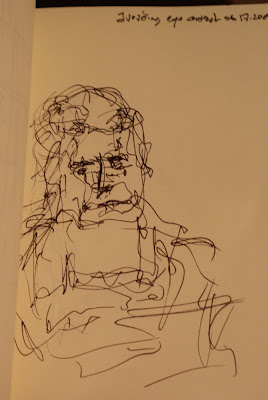
While engaged in this process I was inspired to begin sketching people as often as I could. The best place I could do this as inconspicuously as possible was while riding the subway. I didn't want people to know I was drawing them; it would make the drawings insincere. Because of this I had to work quickly. So, I began to sketch them as quickly as I could. I spent under 30 seconds on each of these, so that I could capture a moment, a connection between a person and their city. The drawings are not of the individuals, per se. Rather they are to evoke that instance where they were immersed in their environment and connected to it, rather than watching me or posing, or even just being "on guard". I wanted to capture these intimate moments like an innocent voyeur smiling at an elderly couple still in love as they stroll through the park on their 50th wedding anniversary. Anyway, here are the sketches; I hope it worked.

I will soon update how these fit into my understanding of the city as my analog of "Common Ground".

faces on the train, part tw0